
A Surprisingly Good Answer
You ask an AI assistant to write an email.
It produces a polished message in seconds.
You ask it to summarize a report.
It identifies the key points.
You ask for ideas.
It returns ten suggestions—some of them genuinely useful.
At that moment, it is natural to wonder:
“Is this machine actually thinking?”
The answer depends on what we mean by “thinking.”
It Looks Like Thinking
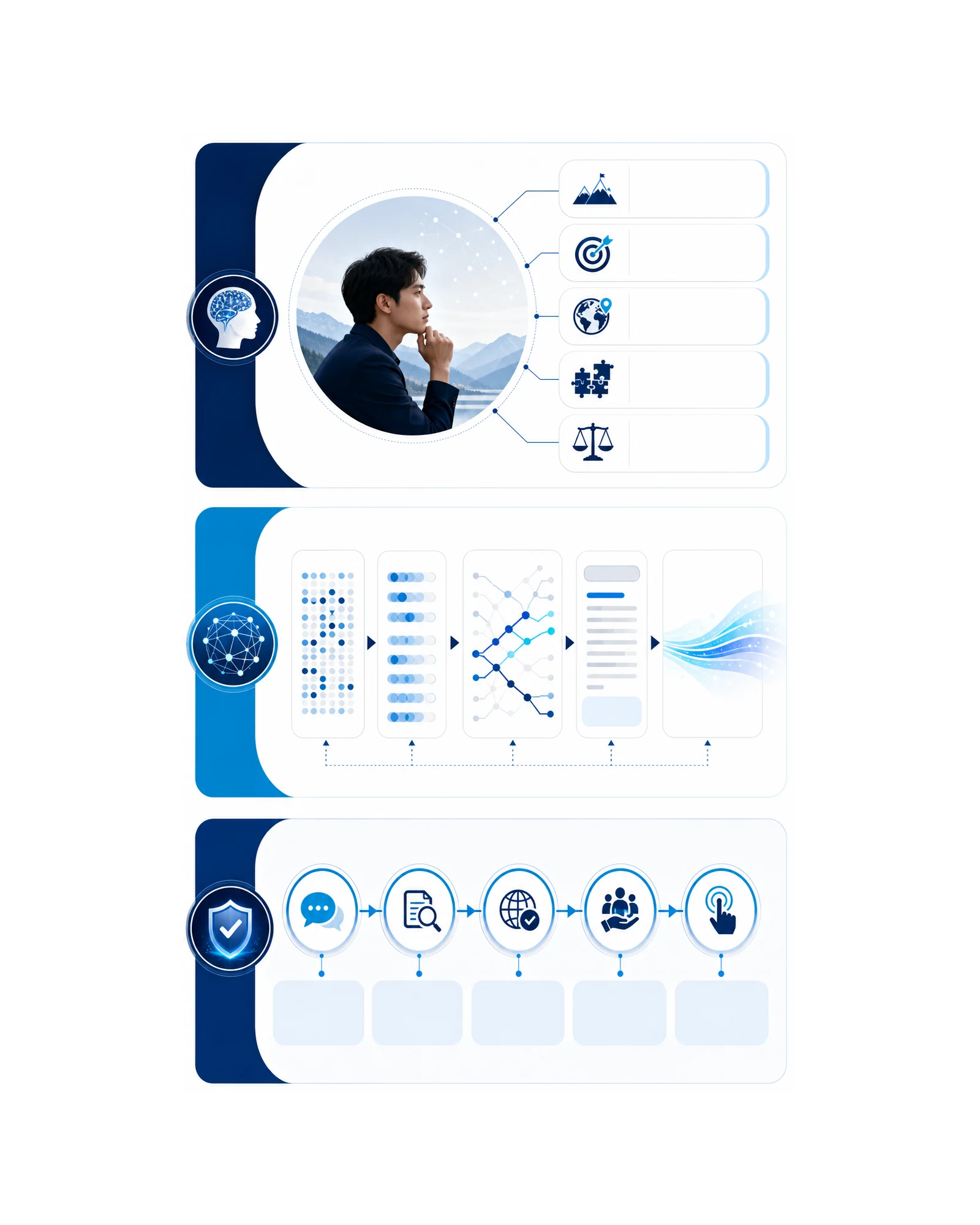
When people think, we connect words with experience.
We remember what happened.
We understand goals.
We notice emotions.
We compare possibilities and make judgments.
A generative AI system works differently.
It analyzes patterns in enormous amounts of data and predicts what content is likely to come next.
That process can produce fluent, relevant, and impressive answers.
But fluent language is not proof of human-like understanding.

The World's Most Powerful Autocomplete?
You may have heard AI described as “autocomplete.”
That description is helpful—but incomplete.
Ordinary autocomplete predicts the next word in a short phrase.
Modern generative AI can work with long instructions, connect many ideas, adapt its tone, summarize documents, generate plans, and revise its own output.
It is far more capable than the autocomplete on your phone.
Still, prediction remains central to how it generates language.
This is why an AI can sound confident even when the answer is wrong.
It is producing a likely answer—not personally remembering an event or checking reality unless it has access to reliable tools and sources.
Coffee Break
Imagine a talented actor playing a doctor on television.
The actor may:
- Use medical vocabulary
- Explain a procedure convincingly
- Wear the correct uniform
- Sound completely confident
But sounding like a doctor is not the same as being responsible for a real diagnosis.
AI presents a similar lesson.
A convincing performance is not always the same as genuine understanding.
Why AI Makes Things Up
AI is designed to generate a useful response.
When information is unclear, missing, outdated, or outside its reliable knowledge, it may still continue producing an answer.
The result can be a fabricated fact, source, quotation, number, or explanation.
This is often called a hallucination.
The term sounds dramatic, but the practical lesson is simple:
AI output must be checked when accuracy matters.

Does That Make AI Useless?
Not at all.
A calculator does not understand finance, but it is extremely useful.
A search engine does not understand your career, but it helps you find information.
Generative AI does not need to think exactly like a human to become a valuable professional tool.
It can help you:
- Generate a first draft
- Summarize information
- Organize ideas
- Compare options
- Improve clarity
- Explore questions
- Prepare routine materials
The key is to match the task with the right level of human review.
PichaiTech Insight
Do not judge AI only by how intelligent it sounds. Judge it by how reliably it performs the task.
For low-risk work, speed may be the priority.
For high-risk work, verification must be the priority.
A brainstorming suggestion and a legal conclusion should never receive the same level of trust.
A Simple Trust Test
Before using an AI answer, ask three questions:
- Can I verify it?
- What happens if it is wrong?
- Who is responsible for the final decision?
If the consequences are serious, use trusted sources, qualified professionals, and documented review.
Try It Today
Ask AI the same workplace question twice.
For example:
“What are the three most important risks in this project?”
Then ask:
“Review your previous answer. What assumptions did you make, and what information would you need to improve it?”
Compare the responses.
You will begin to see an important AI skill:
Do not only ask for an answer. Ask the AI to reveal uncertainty, assumptions, and missing information.
Key Takeaways
- AI can produce intelligent-looking output without human-like understanding.
- Generative AI creates language by learning and using patterns.
- Fluent and confident answers can still be wrong.
- AI remains highly useful when tasks and review levels are chosen carefully.
- The more serious the consequence, the stronger the verification must be.
- Human judgment remains responsible for the final decision.
Tomorrow's Question
Today we asked:
Can AI really think?
Next, we will ask a practical question:
Why does AI sometimes give the wrong answer with complete confidence?
Next Issue: Issue #003 — *Why Is AI So Confident When It Is Wrong?*
FAQ
Questions professionals often ask
Can AI think like a human?
Current generative AI can produce sophisticated responses, but it does not experience the world, remember personal experiences, or understand meaning in exactly the same way humans do.
Why does AI sound so confident?
Generative AI is optimized to produce likely and coherent responses. A fluent response can therefore sound confident even when information is incomplete or incorrect.
What is an AI hallucination?
An AI hallucination is generated information that appears plausible but is false, unsupported, or fabricated.
Can professionals still use AI safely?
Yes. Match the tool to the task, verify important claims, assess the consequences of errors, and keep human responsibility for final decisions.