
Why a Confident Answer Can Still Be Wrong
People often judge information by presentation.
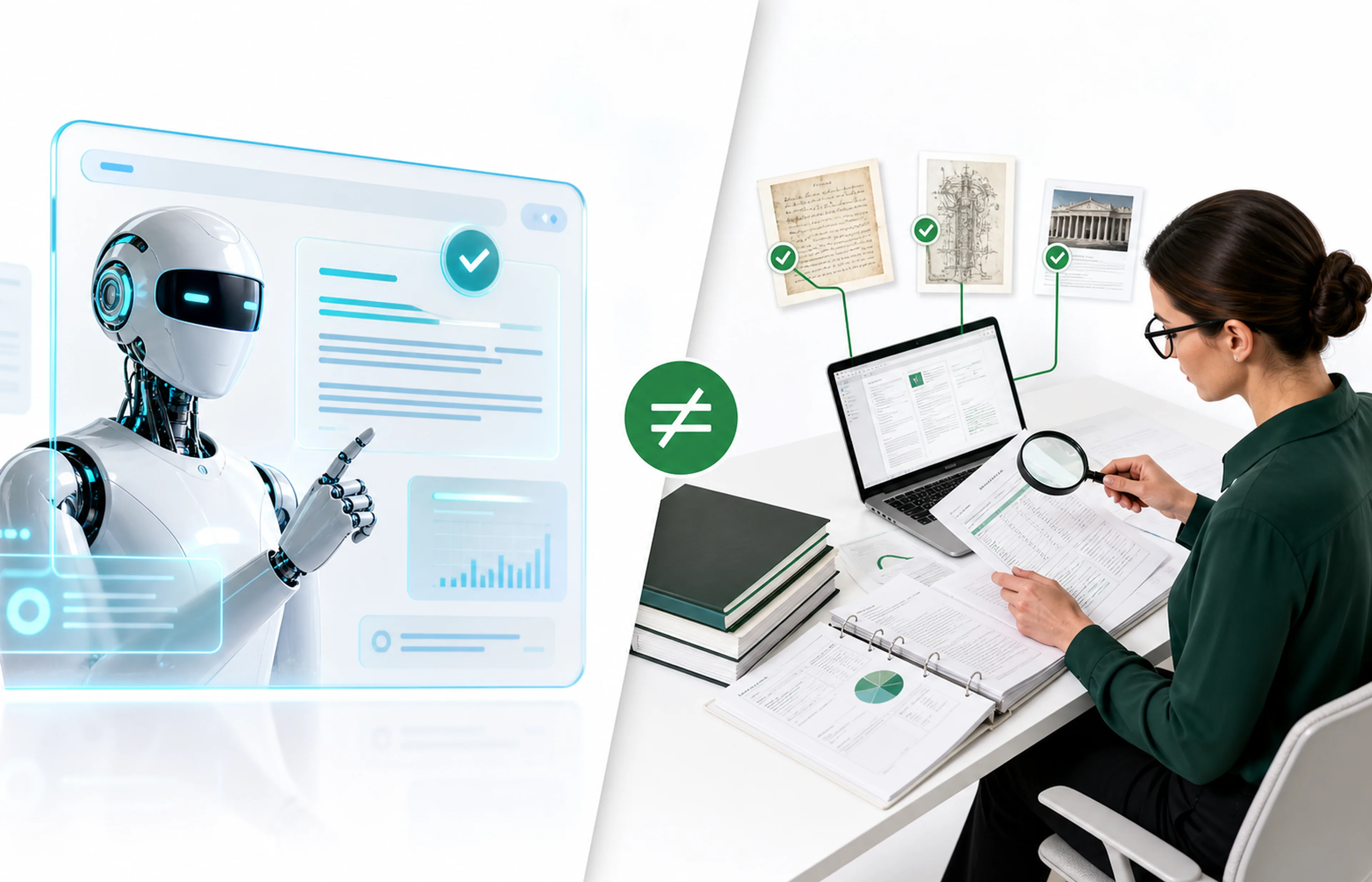
A clear structure feels credible. Specific numbers feel precise. A professional tone feels authoritative. AI can produce all three even when the underlying answer is incomplete.
Common problems include:
- outdated information presented as current;
- a real organization paired with an incorrect policy;
- an invented quotation or citation;
- arithmetic that looks reasonable but is wrong;
- a conclusion that ignores an important exception;
- a recommendation based on assumptions you never provided.
This does not make AI useless. It changes your role.
You are not merely the recipient of an answer. You are the editor, reviewer, and final decision-maker.
Three Levels of Verification
Not every answer requires the same amount of checking.
Level 1 — Low impact
Examples include brainstorming meeting names, rewriting a friendly message, or generating an internal checklist.
A quick review is usually enough. Check that the output matches your intent and contains nothing inappropriate or confidential.
Level 2 — Medium impact
Examples include a customer presentation, management report, training material, operational recommendation, or public social post.
Check facts, names, dates, numbers, and sources. Ask a knowledgeable colleague to review when the topic is outside your expertise.
Level 3 — High impact
Examples include legal obligations, medical decisions, financial commitments, hiring decisions, safety procedures, compliance, product specifications, or public claims that could damage trust.
AI must not be the final authority. Use current primary sources and qualified human review. Record how the conclusion was verified.
The higher the impact, the stronger the evidence must be.

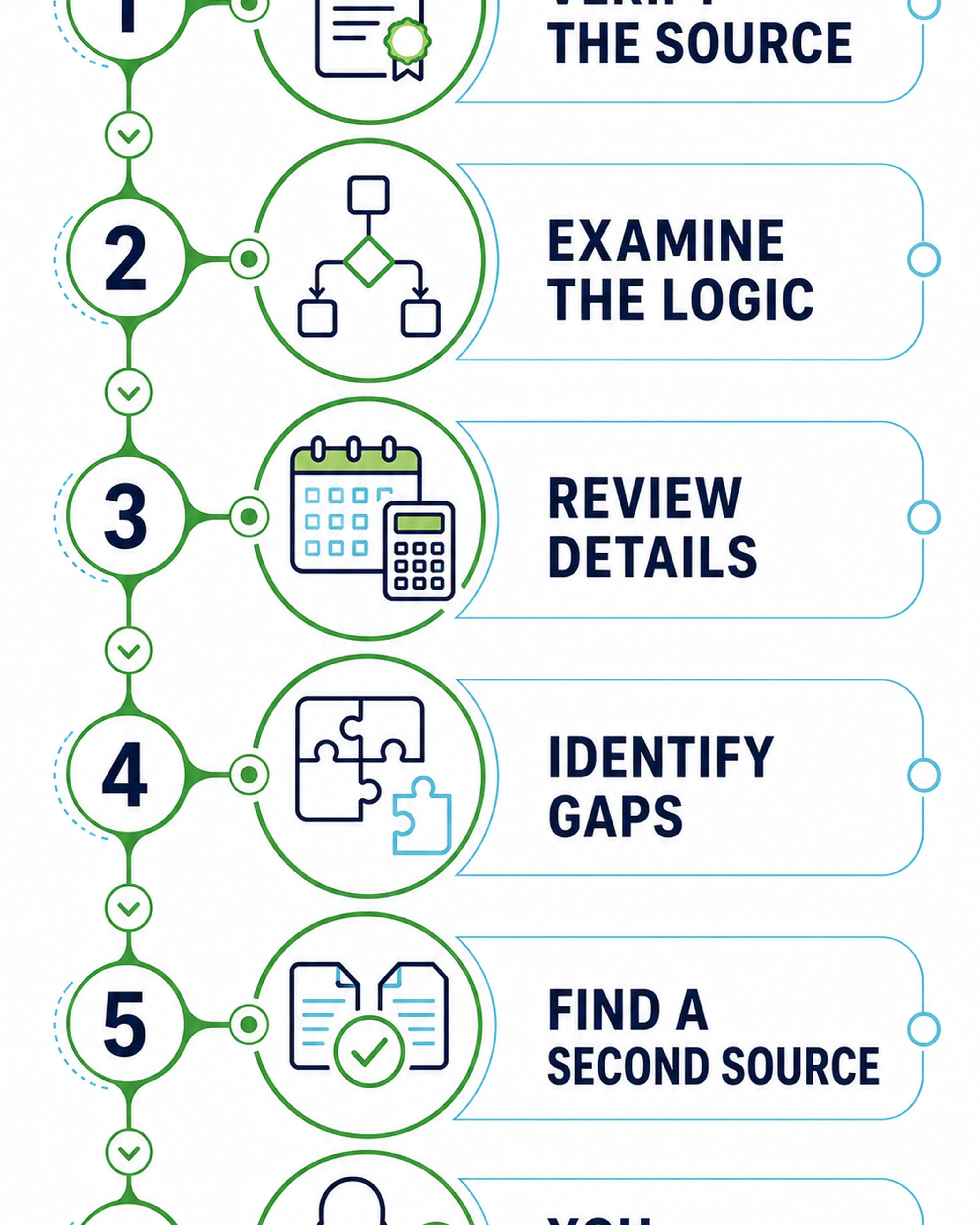
The V.E.R.I.F.Y. Routine
You do not need to investigate every sentence like a detective. Start with the claims that matter most.
V — Verify the source
Ask: Where did this information come from?
When AI cites a source, confirm that the source exists and actually supports the claim. Open the original document rather than relying on a title, snippet, or AI summary.
Prefer primary sources such as official policies, laws, standards, company filings, product documentation, original research, and data from the responsible organization.
A source can be real but still fail to support the specific statement.
E — Examine the logic
Read the reasoning from beginning to end.
Does the conclusion follow from the evidence? Are two different ideas being treated as the same? Has the answer confused correlation with cause? Has it assumed that a practice from one country, industry, or company applies everywhere?
A useful follow-up prompt is:
“List the assumptions behind this recommendation and explain what would make it fail.”
R — Review names, dates, and numbers
Small factual details create large errors.
Check names, job titles, dates, prices, percentages, units, currencies, product versions, legal jurisdictions, and calculation inputs.
For calculations, reproduce the result in a spreadsheet or calculator. Ask AI to show each step, but do not assume the steps are correct merely because they are visible.
I — Identify gaps and uncertainty
Ask what is missing.
Good professional analysis includes uncertainty, limitations, and alternative explanations. If an answer sounds completely certain about a complex subject, ask:
“What important information is missing, and which parts of this answer are least certain?”
Look for missing context, exceptions, opposing evidence, and data that may have changed.
F — Find a second source
Do not verify a claim by asking the same AI the same question again.
Use an independent source. For current company information, check the company. For regulations, check the responsible authority. For research, locate the original paper. For internal matters, consult the approved system of record or the accountable owner.
Independent confirmation is especially important when a claim affects money, people, safety, reputation, or compliance.
Y — You make the final decision
AI can prepare, compare, summarize, and challenge.
It cannot accept responsibility for your decision.
Before using the answer, decide whether the evidence is strong enough for the consequence. If it is not, pause, escalate, or gather more information.
That final judgment is not a weakness in the AI workflow. It is the professional skill that makes the workflow safe.
Workplace Example: A Management Presentation
Imagine that AI writes:
“Companies that adopt AI assistants improve productivity by 40 percent.”
The sentence is attractive. It would look impressive on a slide. But before using it, apply V.E.R.I.F.Y.
- Verify: Is there a traceable study?
- Examine: What does “productivity” mean in that study?
- Review: Is the number 40 percent, 14 percent, or a result for one specific task?
- Identify: Which industries and job roles were included?
- Find: Can an independent source confirm the result?
- You decide: Is the evidence strong enough for a public presentation?
The final slide may need a narrower and more honest statement:
“Some studies have found meaningful productivity gains for specific tasks when AI is used with appropriate human review.”
Less dramatic. More trustworthy.
Numbers Example: The Helpful Spreadsheet Error
Suppose you ask AI to calculate annual savings from reducing a process by six minutes per unit.
AI may calculate quickly, but the result depends on:
- units produced per day;
- operating days per year;
- labor or machine cost per minute;
- whether the six minutes are truly eliminated;
- whether savings are cash savings or only released capacity;
- whether implementation costs were included.
A mathematically correct multiplication can still produce a misleading business conclusion when assumptions are wrong.
Ask AI to create an assumptions table. Then verify each input with the process owner and finance team.
Factory Example: A Maintenance Recommendation
An engineer asks AI why a machine is overheating. AI suggests replacing a cooling fan.
That suggestion may be reasonable, but it must not bypass safe troubleshooting.
The team should check approved manuals, alarms, recent maintenance records, sensor accuracy, airflow restrictions, environmental conditions, and lockout/tagout procedures. A qualified person must decide the action.
AI can help organize possible causes. It must not become an unverified maintenance authority.
Coffee Break
Open an AI answer you used recently.
Choose the most important sentence.
Can you answer these three questions?
- Where did the claim come from?
- What assumption could make it wrong?
- What independent source confirms it?
If you cannot answer, the sentence is not ready for important use.
PichaiTech Insight
AI literacy is not only the ability to get an answer. It is the ability to know what evidence the answer requires.
The fastest professional is not the person who accepts the first output.
It is the person who knows what deserves a quick review, what deserves deeper checking, and what requires an expert.
Try It Today
Use this prompt with a non-confidential AI answer:
“Review your previous answer as a skeptical professional. Separate verified facts, assumptions, estimates, and recommendations. Identify the three claims with the highest risk if wrong. For each claim, tell me what primary source or human expert should verify it. Do not invent citations.”
Then perform at least one independent check yourself.
Key Takeaways
- A polished AI answer is not automatically a correct answer.
- Match the strength of verification to the impact of the decision.
- Verify sources, logic, details, uncertainty, and independent evidence.
- Recalculate important numbers outside the AI response.
- Use qualified human review for high-impact decisions.
- AI can assist the decision; accountability remains with people.
Tomorrow's Question
Verification protects the quality of your work.
But what about the information you give to AI in the first place?
Next Issue: Issue #007 — How to Protect Your Information When Using AI
FAQ
Questions professionals often ask
Can AI answers be wrong even when they sound confident?
Yes. Fluency and confidence are not evidence of accuracy.
What should I verify first?
Start with high-impact claims, sources, names, dates, numbers, and assumptions.
Is asking AI again enough to verify an answer?
No. Use an independent source or accountable human expert.
When is expert review required?
For legal, medical, financial, safety, compliance, employment, or other high-impact decisions.
Can AI check its own answer?
It can identify possible weaknesses, but independent verification remains necessary.